Founder of the month: mableAI
What does your company stand for?
Mable helps online stores attract more customers and become more profitable through advertising on Instagram, Facebook, and Google. To do this, we ensure that advertising algorithms receive complete and accurate data from the online stores—in compliance with data protection regulations and based on the consent of store visitors.
In addition, we enrich this data with key business insights, such as whether a purchase was made by a new customer or how profitable that customer is. This enables companies to tailor their advertising specifically to their business goals.
Where and how did you come up with the brilliant idea to start the company?
The idea originated from a project at my innovation consulting firm, which I founded in 2020. While setting up the digital sales operations for a major insurance company, Apple’s iOS 14.5 privacy update presented us with new challenges. Important tracking data was lost, and the advertising algorithms could no longer learn reliably.
After testing various solutions, we developed our own technology to improve data quality. It quickly became clear that this problem affects many companies. That’s how Mable GbR was founded in October 2021.
How did the founding team come together?
Our team is united by our shared history at KIT. I met my two original co-founders during my studies and at a startup barbecue hosted by the KIT Start-up Incubator, respectively. Both have since left Mable.
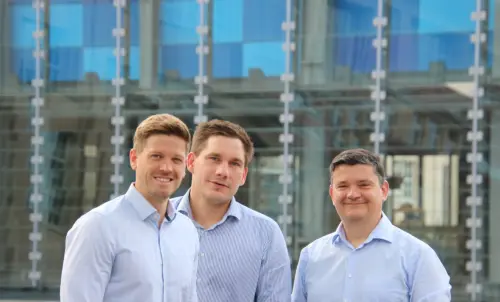
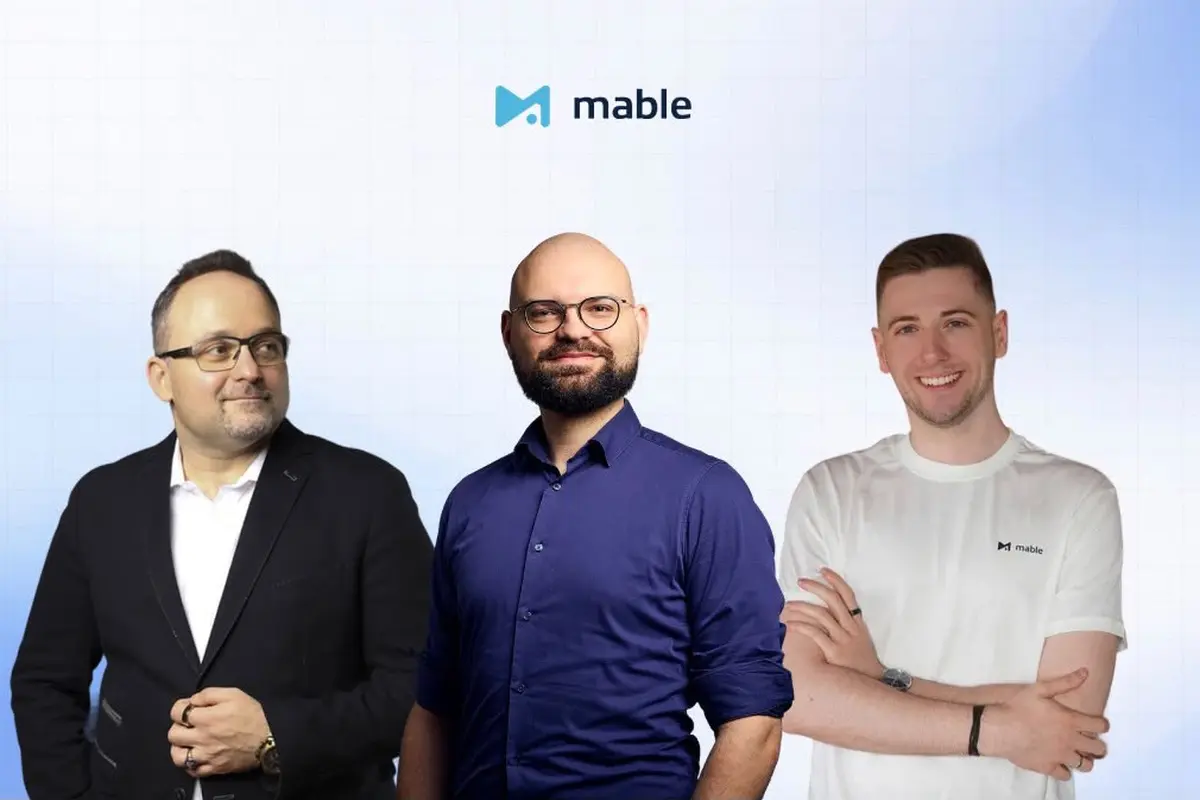
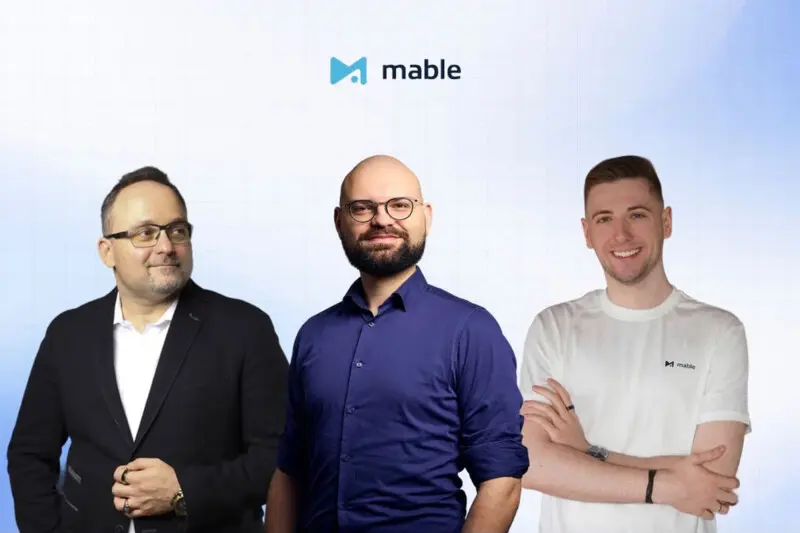
Nikita, our current CPO & CHRO, has been my best friend since kindergarten and joined us as an intern in 2022. Horst, our CTO & COO, joined the company during our pre-seed funding round and later took on an operational role. Today, the three of us lead Mable.
What sets Mable apart from traditional tracking tools?
Traditional tracking tools focus primarily on capturing data as comprehensively as possible. For us, that’s just the foundation.
The real added value lies in what information is passed on to the advertising algorithms. With our algorithm training approach, companies can optimize their advertising specifically for new customers or particularly profitable orders, rather than focusing solely on revenue.
Where do you see significant hurdles in the startup process?
Our biggest hurdle was bureaucracy. Since Mable grew out of my existing innovation consulting firm, we had to legally transfer the software to the new GmbH in order to attract investment.
This process was significantly more time-consuming than expected and kept us busy long after the company was actually founded.
Where did you go for support?
My first startup in 2016 is what first connected me to the KIT-Gründerschmiede. But what was particularly valuable for Mable was learning from the experiences of other founders in our industry.
The CyberForum also played an important role. At a pitch event, we were able to connect with investors who later supported our pre-seed funding. Today, we also benefit from an experienced advisory board.
Why did you decide to completely redevelop Mable 2.0 from scratch?
As we grew, our original platform increasingly reached its limits. That’s why we decided to completely rebuild the software from scratch, rather than continuing to tweak the existing prototype.
To do this, we deliberately put further growth on hold for twelve months. Mable 2.0 launched at the end of June 2025. By the end of the year, we had migrated over 200 existing customers to the new platform. It was a major challenge, but one that paid off for us.
First pilot customer, first prototype, what did you learn?
We deliberately kept our first product simple. Working with an agency, we tested it with five e-commerce brands starting in April 2022.
Our most important lesson was that we shouldn’t just evaluate technical solutions based on their theoretical functionality, but also continuously measure their results. We also learned that comprehensive data alone isn’t enough; what matters most is that it reflects our customers’ actual business goals.
What has changed since the organization was formally established?
The key difference was the ability to bring in investors. In June 2022, Mable GbR became a GmbH. This allowed us to conduct our first round of financing and accelerate the further growth of our company.
How did you solve the funding problem?
I self-funded the first product development using profits from my innovation consulting business. Just a few months after the market launch in 2022, we reached the break-even point.
We then decided to conduct a pre-seed funding round with business angels and institutional investors to accelerate our growth. Currently, we are focusing on profitability so that, in the long term, we can independently decide whether to continue growing on our own or to raise additional capital.
What are your next major milestones over the next twelve months?
We would like to further expand our sales, marketing, and customer success teams and make the specific value our platform offers customers even more visible.
Another important step is our expansion into the U.S. We already have our first customers there. Going forward, we want to grow our presence with our own on-site team and collaborate more closely with performance marketing agencies.
In your opinion, what qualities should a founder have?
From our perspective, five qualities are particularly crucial: optimism, resilience, independent thinking, self-confidence, and humility.
Especially when starting a business, you have to be willing to accept setbacks, learn from your experiences, and still hold fast to your vision.