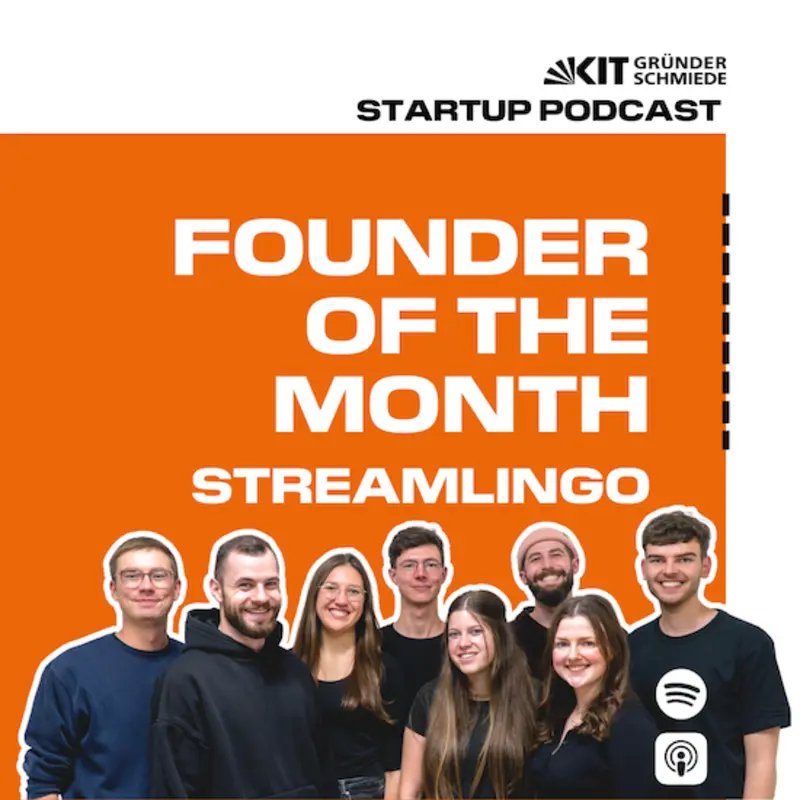
Founder of the month: Streamlingo
Has anything changed for you since the formal founding?
Absolutely! Since the GmbH was founded in May 2025, everything feels more professional and binding. We are no longer hobbyists, but a real company with real responsibilities—which naturally brings more pressure, but also more motivation.
A major milestone was that we were able to apply for BW Preseed after the company was founded. The approval helped us enormously – we now have significantly more financial resources available to grow and invest specifically in development and sales.
In practical terms, the change is that we can now hire employees and finally delegate tasks that previously overwhelmed us. This gives us more breathing room to focus on the essentials: further developing the product and winning new customers.
How did you solve the problem of (follow-up) financing?
We are currently financing ourselves mainly through grants. The EXIST start-up grant gave us the necessary support in the initial phase to get started in the first place. This was followed by funding from L-Bank, which gave us further scope. This gave us the financial resources to invest specifically in development and sales and to expand our team. Now we can really scale up.
At the same time, we are already generating revenue from our customers. Over 90 municipalities use Streamlingo regularly, and this customer base is growing steadily. Our goal is to become cash flow positive and then independent of subsidies. We have deliberately not brought any large investors on board yet. We first wanted to prove that our business model works and grow organically.
Are current global crises affecting your startup?
We are not directly affected, as we are purely a software company and do not manufacture physical products or have supply chains.
On the contrary, many church communities use Streamlingo because they need Ukrainian translations. Since the war in Ukraine, many refugees have arrived in Germany who would like to participate in community life but do not understand the language. For these churches, Streamlingo is a real solution for integrating these people and making them feel like they belong. This also shows how important our tool is – not only technically, but also on a human level. We help to enable community, especially in difficult times.
What are your next big milestones in the coming 12 months?
We have a lot planned for the next 12 months:
- Scaling in Europe: We want to significantly expand our customer base – from currently over 90 customers to five hundred. To do this, we are specifically hiring sales staff and expanding our marketing.
- Rollout in the UK: We already have a sales partner in the UK and want to gain a firm foothold there. The UK market offers enormous potential, and we are excited to see how Streamlingo will be received there.
- Product development: We are working on new features such as automatic transcription of lectures/sermons and the creation of summaries. In the long term, we want to help communities get the most out of their content and provide support where help is needed.
- Cash flow positivity: An important goal is to become cash flow positive in the next 12 months so that we are independent of subsidies and can continue to grow organically.
In your opinion, what qualities should a founder have?
For us, the most important quality is perseverance. There will always be moments when things don’t go as planned—whether it’s team members leaving, technical problems cropping up, or customers hesitating. You have to be prepared to keep going even during frustrating phases and believe in your own vision.
Added to this is a willingness to learn. As a founder, you constantly have to familiarize yourself with new topics—from taxes and law to marketing and sales. You can’t know everything, but you have to be willing to learn everything or find the right people to help you.
And very importantly: enthusiasm for the project. If you’re not convinced by your idea yourself and passionate about it, it will be difficult to get others on board – whether they’re customers, employees, or sponsors. This enthusiasm is contagious and will carry you through difficult times.
Do you have any practical tips for other young entrepreneurs?
Get support early on: Take advantage of offers such as CyberForum, CyberLab, or accelerator programs. We learned an incredible amount there and made valuable contacts. You don’t have to reinvent the wheel—others have already gone down that road and can save you a lot of detours.
Make the most of AI tools: AI tools such as Claude, ChatGPT, and the like are worth their weight in gold! You can use them to ask all kinds of questions, write texts, debug code, or familiarize yourself with new topics – all in a matter of seconds. Large companies are often not allowed to use AI tools to the extent that would actually be possible for legal or compliance reasons. This gives us start-ups an enormous advantage: We can be faster, work more agilely, and try things that others can only implement in months. Take advantage of that!
Focus on a niche: It’s tempting to want to be everything to everyone, but it’s better to specialize in a target group and make the best product for them. For us, that’s church communities – and it’s precisely this focus that helps us to be better than the competition.
Stay close to your customers: Talk to your users, listen to them, and build your product based on real feedback. We test with communities every week and learn an incredible amount in the process.
Find the right team: Only work with people who are as passionate about the project as you are. If someone isn’t 100% committed, it won’t work sooner or later.
Looking back, what would you do differently?
That’s actually a difficult question because, in retrospect, we’re pretty happy with the path we’ve taken. Of course, you could always say “more customers” or “grow faster,” but we set our priorities very deliberately.
One thing we could have tackled earlier is a global billing system. That would have saved us some work later on. However, it would also have meant dealing with international legal and tax issues much earlier—and we simply didn’t have the capacity for that at the time. Sometimes you have to work through things one by one, even if you know they will be important at some point.
Otherwise, we shouldn’t have done more sales earlier on. Our product had to be stable before we could really scale up. That was the right decision, even if it was sometimes difficult to remain patient.