Mastermind of the future
13.05.2020 Daniela Musial-Lemberg News
HQS Quantum Simulations develops ideas to make quantum computers marketable for use in medical or energy research.

With the certificate, the Falling Walls Foundation wants to stimulate a cultural change – towards more creativity, more courage for the transfer of innovative technologies and concepts and more acceptance of research careers beyond the professorship. The basis for the award was the fulfilment of quality standards in the application and implementation of awareness-raising measures by KIT in cooperation with Young Entrepreneurs in Science. The certificate is valid for one year and can be extended by a renewed examination by Young Entrepreneurs in Science.

The Falling Walls Foundation is the unique global hub connecting science, business and society. It shapes the future of humanity through impact-driven ideas and discoveries, driven by a shared commitment to creating breakthroughs across borders and disciplines.

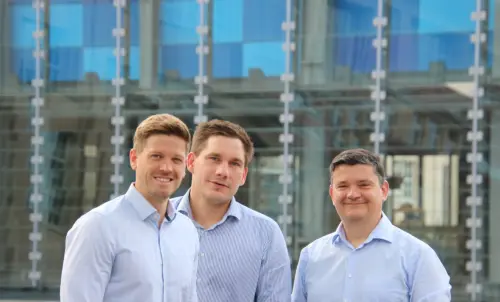
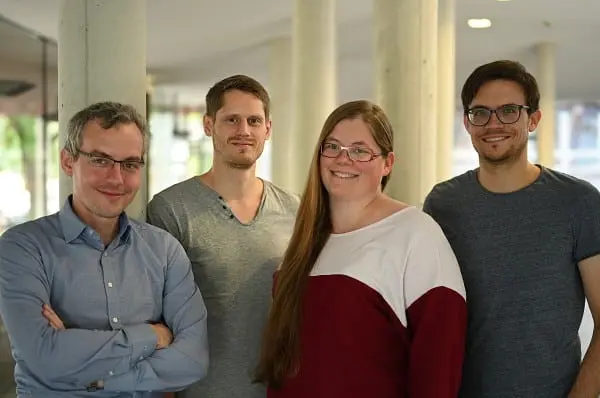
With their development, the Karlsruhe scientists are in a global race. For four years, the four scientists Dr. Iris Schwenk, Dr. Michael Marthaler, Dr. Jan Reiner and Dr. Sebastian Zanker conducted research in the field of solid-state physics and quantum computing at the Karlsruhe Institute of Technology (KIT) before taking the leap into self-employment. At the end of 2017, they founded their DeepTech start-up, which develops software for simulating molecules and materials that can be accelerated on quantum computers in perspective.

In particular, this should enable chemists and materials scientists to perform complex simulations. “Companies, such as IBM or Alibaba, already offer small quantum computers via cloud access,” explains Dr. Iris Schwenk from the founding team. “More and more companies in chemical, pharmaceutical or even materials research are asking themselves how and from when they can use quantum computers to accelerate their development cycles. Quantum computing will fundamentally change materials and drug research and development.” And that’s where HQS’ work comes in. The spin-off is working on algorithms to use quantum computers to gain new insights into chemical and physical relationships.

Already today, development processes for customers can be significantly accelerated and the understanding of chemical and physical relationships increased, which at the same time allows faster realization of new processes and products. “With our software, we enable our customers to benefit from the enormous opportunities and minimize the risks of change through customized simulation solutions that can easily be converted to the upcoming quantum hardware,” continues Schwenk, a physicist.
There is great interest from industry

Initial projects are already underway with BASF, Bosch and Merck. In 2019, the founding team received 2.3 million euros in capital for the next steps via a financing round. But the road to this point was not always easy and involved many learning processes. “For spin-offs from the academic field, it is often quite difficult to focus fully on customer benefits and not get lost in the playground of fascinating technologies,” Schwenk recalls of the early days of start-up life. “Questions about how to address and win customers seemed very daunting at first. This is where the KIT-Gründerschmiede team and especially the upCAT program from Entechnon helped us a lot. Through this, we started to build contacts in the industry and really understand what is relevant for potential customers.”

Consulting inquiry

Contact form

For consulting inquiries, please use our separate consulting inquiry form.